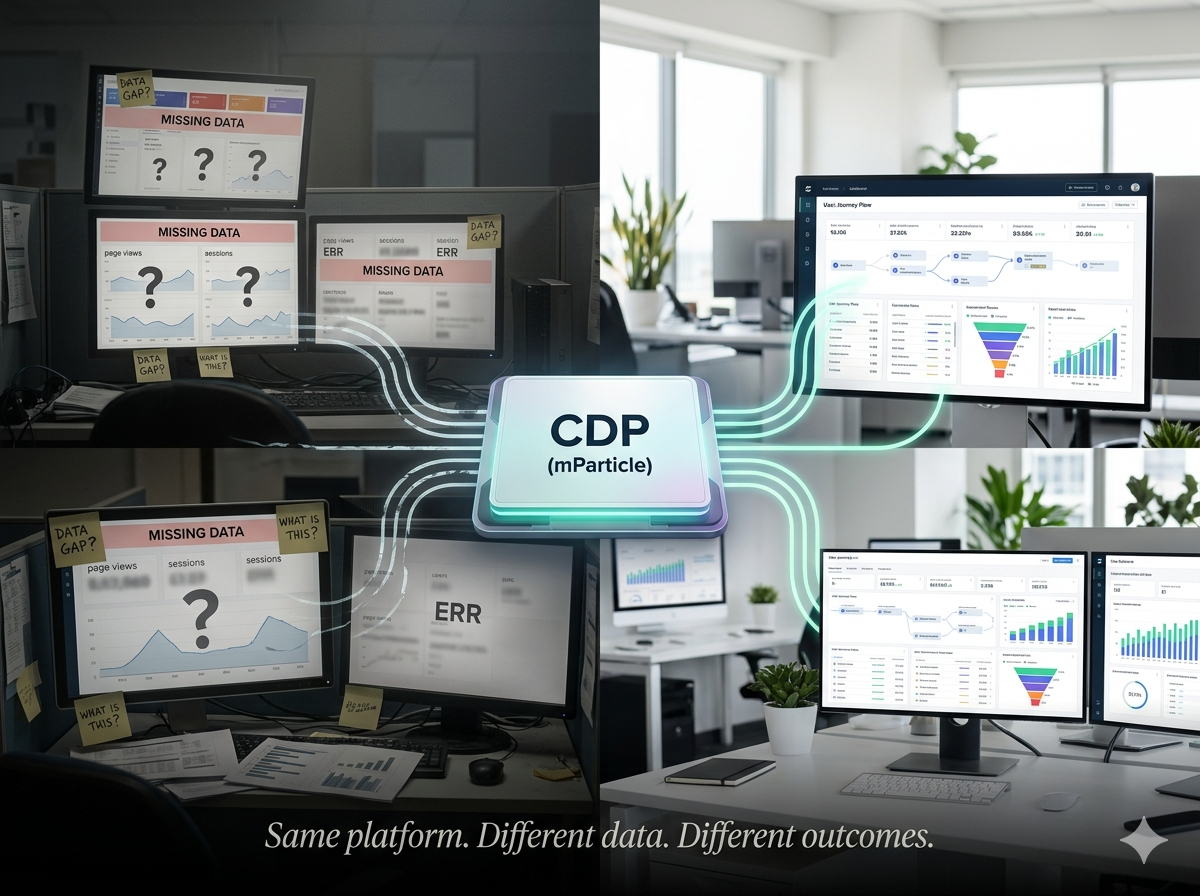
Your CDP is only as good as the data you feed it
Most teams today believe that implementing a Customer Data Platform is the turning point.
The moment where data finally becomes actionable. Where personalization improves. Where decisions get smarter.
But in practice… that’s rarely what happens.
Because the real problem doesn’t start in the CDP.
It starts in the data.
THE HIDDEN ASSUMPTION
There’s an implicit belief behind most data stacks: “If we centralize our data, we’ll understand our users.”
But centralizing incomplete data doesn’t solve the problem. It just scales it.
If your inputs are shallow… your outputs will be too.
WHAT MOST IMPLEMENTATIONS ACTUALLY CAPTURE
In many organizations, the data layer still looks like this:
- Page views
- Click events
- Session-based metrics
- Basic time-on-page
At first glance, this seems sufficient.
But when you look closer, something critical is missing: 👉 Actual user engagement
Not inferred. Not approximated. But real signals of attention and behavior.
THE CONSEQUENCE: INTELLIGENT SYSTEMS... WITH BLIND SPOTS
Platforms like mParticle are incredibly powerful.
They can:
- Orchestrate data across tools
- Build dynamic audiences
- Trigger real-time experiences
But they all share the same dependency: 👉 They rely entirely on the quality of the data they receive.
If the input lacks depth, context, or accuracy… then even the best orchestration leads to:
- Segments that don’t reflect real behavior
- Personalization based on weak signals
- Insights that feel right… but aren’t complete
THE REAL ISSUE: THE MISSING SIGNAL LAYER
What most stacks lack is not another tool.
It’s a better understanding of what users actually do.
Questions like:
- Did the user actually read the content?
- How far did they scroll before losing interest?
- Was the page truly consumed… or just loaded?
- What was the context of their attention?
These are not edge cases.
They are the difference between: 👉 guessing behavior 👉 and measuring it
A SHIFT IN PERSPECTIVE
Before optimizing activation… before adding more tools… before building more dashboards…
There’s a more fundamental question to answer: Are we capturing the right signals in the first place?
Because: 👉 Activation is only as good as the input. 👉 Intelligence is only as good as the signal.
FINAL THOUGHT
Most analytics challenges don’t start in the dashboard. They start much earlier—at the point of data collection.
And until that layer is solved, everything built on top will always have limitations.