WHAT YOUR CDP DOESN’T SEE (BUT SHOULD)
We talked about a simple idea: Your CDP is only as good as the data you feed it.
Today, let’s go one layer deeper.
Because the real issue is not just data quality.
It’s data blindness.
THE ILLUSION OF VISIBILITY
Most teams feel like they understand their users.
They have dashboards. They track events. They see funnels, sessions, conversions.
On paper, everything looks measurable.
But here’s the uncomfortable truth:
👉 Most of what we call “engagement” is inferred… not observed.
WHAT WE THINK WE MEASURE VS. WHAT ACTUALLY HAPPENS
Let’s take a simple example: a content page.
Your analytics might tell you:
- The user stayed for 2 minutes
- They triggered a scroll event
- They didn’t bounce
Sounds like engagement, right?
But what actually happened?
- Did they read the content… or leave the tab open?
- Did they scroll intentionally… or just flick past it?
- Did they pay attention… or get distracted halfway through?
👉 The system doesn’t know.
Because it was never designed to.
THE MISSING SIGNALS
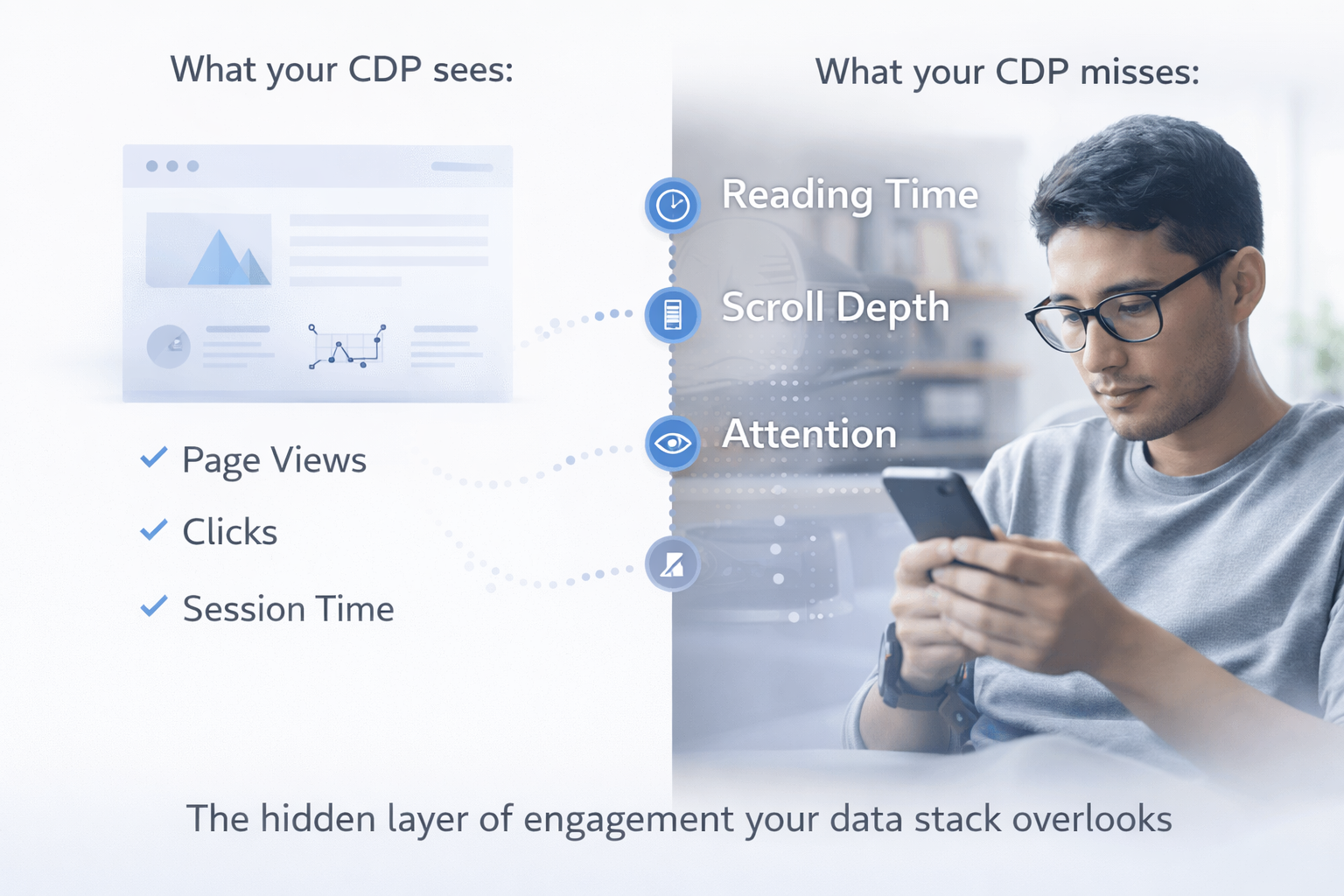
Most data stacks today are built around events, not attention.
They capture:
- Clicks
- Page loads
- Navigation paths
But they miss:
- Real reading time
- Scroll depth with context
- Content consumption patterns
- Attention drop-off moments
- Interaction vs. passive presence
This is the gap.
Not a tooling gap. A visibility gap.
WHY THIS MATTERS MORE THAN IT SEEMS
Platforms like mParticle are incredibly effective at moving data where it needs to go.
But they don’t define what gets collected.
So if the incoming data lacks depth…
👉 The entire downstream system inherits that limitation.
Which means:
- Segments are built on partial behavior
- Personalization reacts to weak signals
- Optimization is based on assumptions
THE COST OF NOT SEEING CLEARLY
When you can’t truly observe engagement, you start to compensate:
- You create proxy metrics
- You rely on averages
- You optimize for what’s easy to measure
And over time, that leads to:
👉 Decisions that feel data-driven… but aren’t fully grounded in reality
A BETTER QUESTION TO ASK
Instead of asking: “How do we activate our data better?”
There’s a more important question: “What are we not seeing today?”
Because the biggest opportunity is not in more dashboards.
It’s in capturing the signals that were never there to begin with.
FINAL THOUGHT
Your CDP is not broken. Your tools are not failing.
They’re doing exactly what they were designed to do.
The real opportunity lies in expanding what they can see.