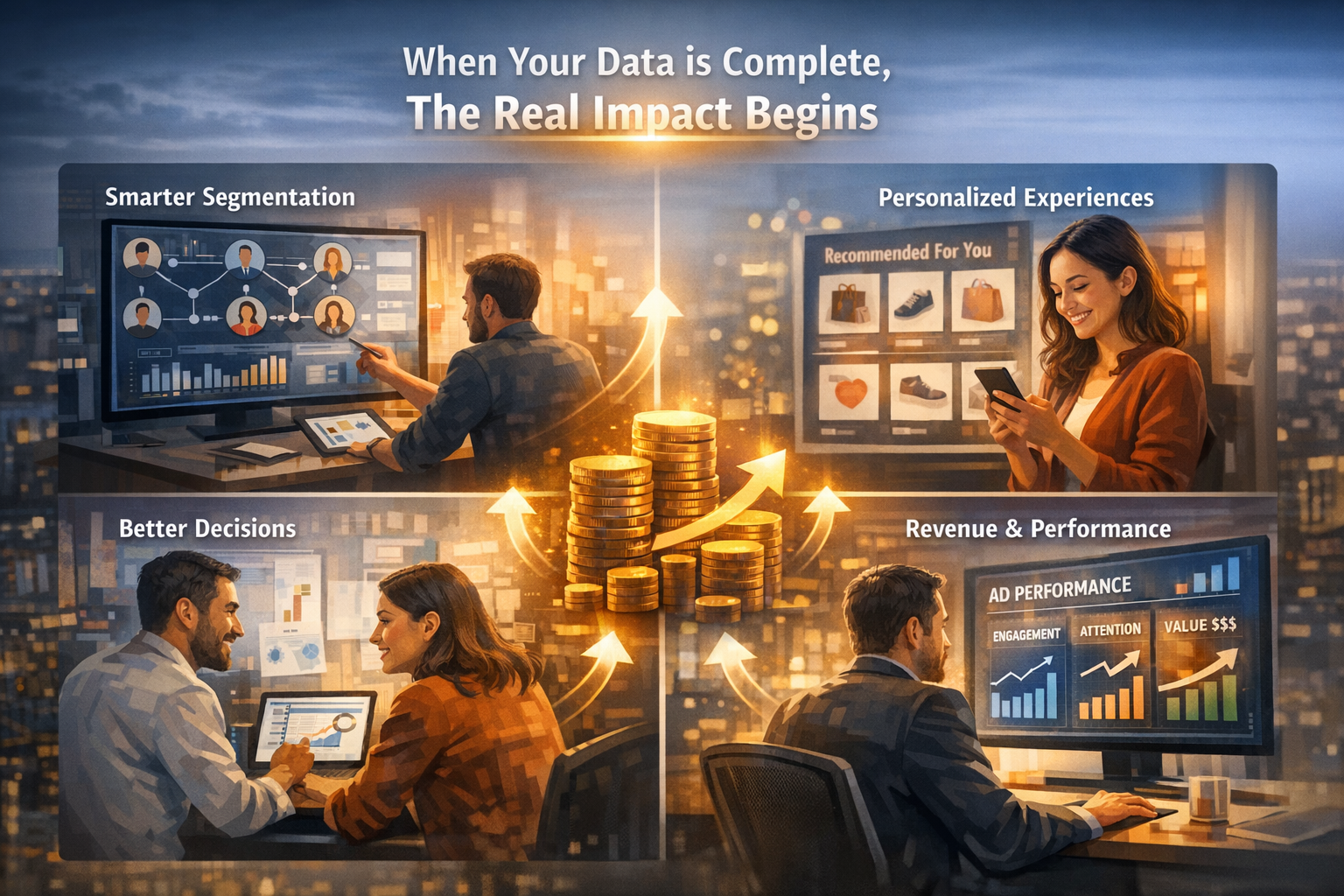
WHAT HAPPENS WHEN YOUR DATA IS FINALLY COMPLETE
So far this week, we’ve talked about:
- Why your CDP is only as good as the data you feed it
- What most systems fail to capture
- And how adding a real signal layer changes the flow
Now let’s make it practical.
What actually changes when your data is no longer incomplete?
FROM ASSUMPTIONS → TO ACTUAL BEHAVIOR
Most teams today operate on proxies:
- Time-on-page instead of real attention
- Clicks instead of intent
- Sessions instead of engagement
And because of that, decisions are often based on:
👉 what looks right… not what is right
When you introduce deeper signals into the system, something shifts:
👉 You stop approximating behavior 👉 And start observing it
WHAT THIS UNLOCKS ACROSS YOUR STACK
When enriched signals flow through platforms like mParticle, the impact is immediate—and cross-functional.
- Smarter audience segmentation
Instead of grouping users by:
- Pages visited
- Number of clicks
You can segment by:
- Actual content consumption
- Depth of engagement
- Attention patterns
👉 Not just who clicked 👉 But who actually cared
- More meaningful personalization
Most personalization today reacts to surface-level signals.
But when your data includes real engagement:
- You recommend based on what users truly consumed
- You adapt experiences based on attention, not just activity
👉 Personalization stops being reactive 👉 And becomes context-aware
- Better product and content decisions
Product and editorial teams often rely on:
- Bounce rate
- Average time
- Scroll events
But these don’t answer the real question: Did the user actually engage?
With deeper signals:
- You see where attention drops
- What content holds interest
- What gets ignored
👉 You stop guessing what works 👉 And start measuring it clearly
- More accurate performance and monetization
For revenue and ad teams, this is critical.
Instead of optimizing for:
- Impressions
- Click-through rates
You can optimize for:
- Real exposure
- Attention duration
- Engagement quality
👉 Not just visibility 👉 But actual value delivered
THE BIGGER SHIFT
This isn’t about adding more metrics.
It’s about changing the quality of decision-making across the organization.
Because when your data reflects reality:
- Teams align faster
- Experiments become more reliable
- Insights become more actionable
FINAL THOUGHT
Most companies don’t have a tooling problem.
They have a visibility problem.
And once that’s solved:
👉 Everything downstream—segmentation, personalization, analytics, monetization—starts working the way it was supposed to.