We built a beautiful data lake. Automated pipelines. Clean dashboards. Everything connected.
And the first thing our stakeholders said was: "I don't trust these numbers." Sound familiar?
After months of engineering work, the real blocker wasn't the technology — it was trust. And that's a much harder problem to solve.
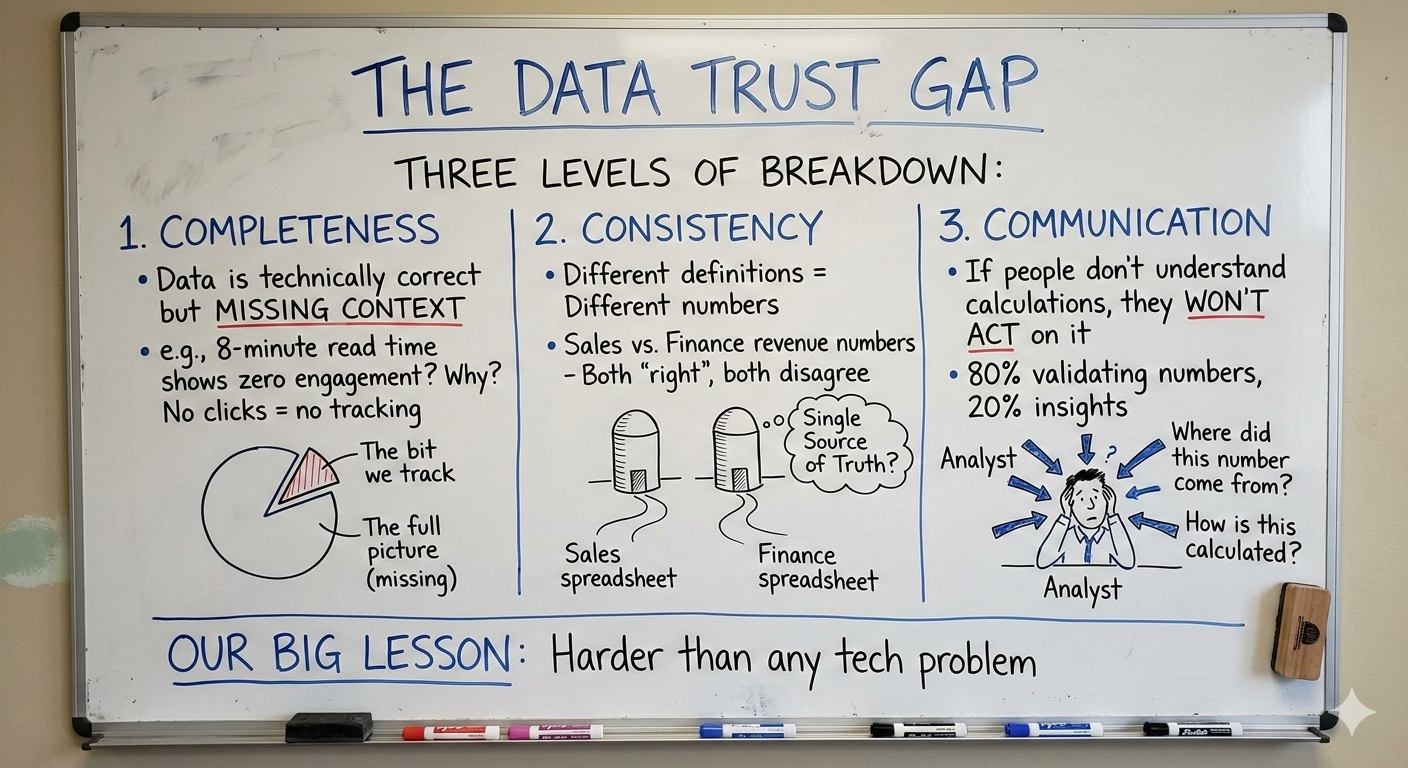
Here's what we've learned: data trust breaks down at three levels.
-
Completeness — The data is technically correct, but it's missing context. A reader spends 8 minutes on your best article and your analytics show zero engagement. Why? Because they arrived, read, and left without clicking anything. The data isn't wrong — it's just incomplete. And incomplete data destroys confidence faster than wrong data.
-
Consistency — Different teams pull the same metric and get different numbers. Sales says revenue is up. Finance says it's flat. Both are right, both are using different definitions. Nobody agrees on the single source of truth, so everyone builds their own spreadsheet. And now you have five versions of reality.
-
Communication — Even when the data is complete and consistent, if people don't understand where it comes from and how it's calculated, they won't act on it. Analysts end up spending 80% of their time validating numbers instead of generating insights. The result? Organizations that have more data than ever, but less confidence in it than ever.
At Luminal Analytics, this is something we think about every day. Not just how to collect better data — but how to make it something people actually believe in and act on. Closing that gap between "the data exists" and "the data is trusted" is harder than any technical problem we've faced.
And honestly, it never fully goes away. It requires constant work: better documentation, clearer definitions, and always asking — does this number tell the whole story?