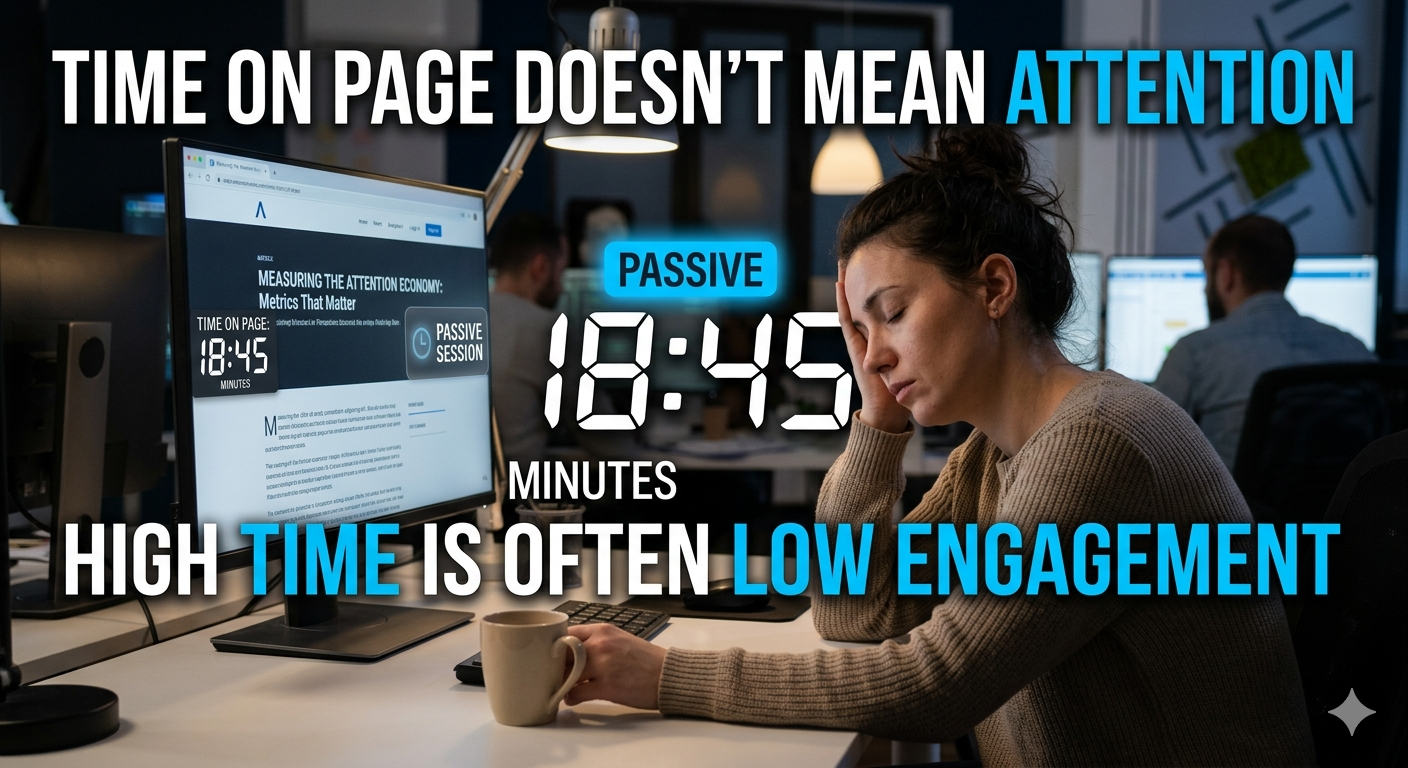
“Time on page” has become one of the most trusted metrics in analytics.
It shows up everywhere:
- Dashboards
- Reports
- Performance reviews
And it feels intuitive: 👉 More time = more engagement 👉 Less time = less interest
Simple.
But not accurate.
Because time on page doesn’t measure attention. It measures… time. And those are not the same thing.
Think about real behavior: A user opens an article Gets distracted Leaves the tab open
From an analytics perspective: 👉 That session looks highly engaged
But in reality? There was no attention at all.
Now flip the scenario:
- A user opens an article
- Reads it fully in 45 seconds
- Gets exactly what they needed
- Leaves
From a dashboard: 👉 That might look like low engagement But that was a perfect interaction
So now you have a problem: 👉 High time ≠ high attention 👉 Low time ≠ low value
And yet… Teams continue to use time as a proxy for engagement.
This creates a subtle but critical distortion: Content gets optimized to hold time -> not to deliver value UX decisions aim to increase duration —> not improve experience
Teams celebrate longer sessions without knowing if anyone was actually paying attention
The issue isn’t that time is useless.
It’s that it’s incomplete… on its own.
Because attention is not passive.
It’s active.
It requires: 👉 Visibility (was the content actually seen?) 👉 Interaction (was the user engaged?) 👉 Continuity (was attention sustained?)
Without that… You’re not measuring attention. You’re assuming it.
And assumptions… are a dangerous foundation for decisions.