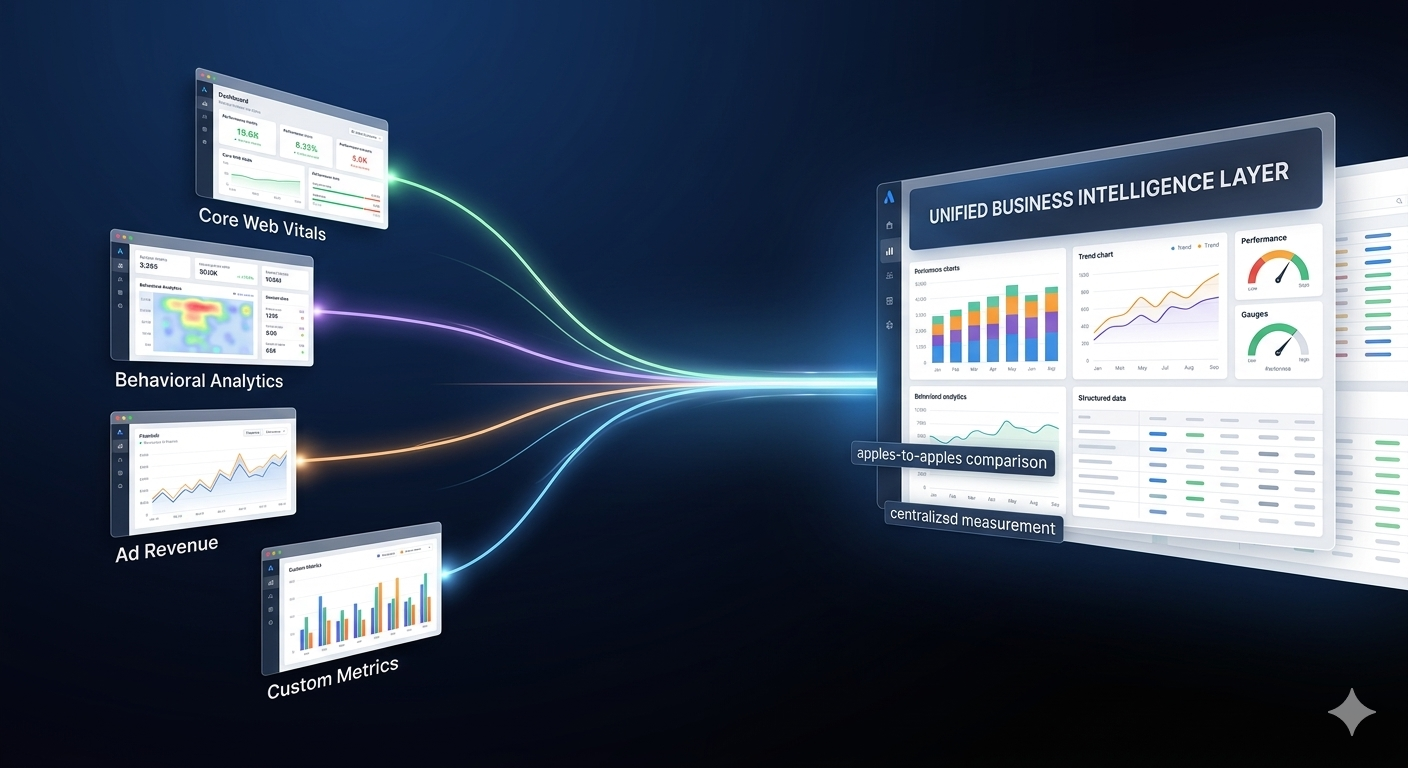
One of the biggest analytics problems companies face is not a lack of data.
It is having the same user journey fragmented across too many systems.
Core Web Vitals are often reviewed in tools like Google Search Console, PageSpeed Insights, or CrUX. Behavioral data typically lives in Google Analytics 4 or product analytics platforms through events and custom parameters. Ad delivery and revenue metrics usually sit inside ad-server reporting tools like Google Ad Manager. And then teams often add even more custom KPIs in internal dashboards or warehouse models.
The result is familiar to almost every data team:
- Different platforms.
- Different definitions.
- Different timestamps.
- Different levels of granularity.
- And too much time spent trying to reconcile numbers before anyone can even start learning from them.
That is a real business problem.
Because when engagement, performance, and monetization signals are separated across disconnected systems, teams stop doing apples-to-apples analysis and start comparing partial versions of the truth.
A page may look healthy in one platform and weak in another. A revenue shift may appear without the engagement context behind it. A performance issue may be visible in a Google tool, but disconnected from the behavioral impact it caused. And custom internal metrics may be useful, but hard to line up consistently against external platforms.
This is exactly why a centralized approach matters.
At Luminal Analytics, we believe the advantage is not just collecting more metrics. It is collecting the right metrics together, in a way that removes ambiguity and creates a shared foundation for analysis.
When engagement signals, experience signals, and monetization context are captured in one centralized stream, teams can finally evaluate behavior with much more consistency.
That means: ** clearer comparisons across pages, templates, experiences, and audiences ** less reconciliation work across disconnected tools ** better confidence in the story behind the numbers ** and faster decisions because the data is already aligned
Behavioral analytics platforms like Amplitude are powerful because they help teams analyze engagement, segmentation, retention, and user behavior in one place. But the quality of that analysis still depends on the quality and completeness of the data feeding it.
That is where Luminal creates value: bringing together the engagement, experience, and revenue-aware signals that are too often scattered across separate tools — and making them available in a centralized, comparable form.
Because better analysis does not start with more dashboards.
It starts with fewer discrepancies.