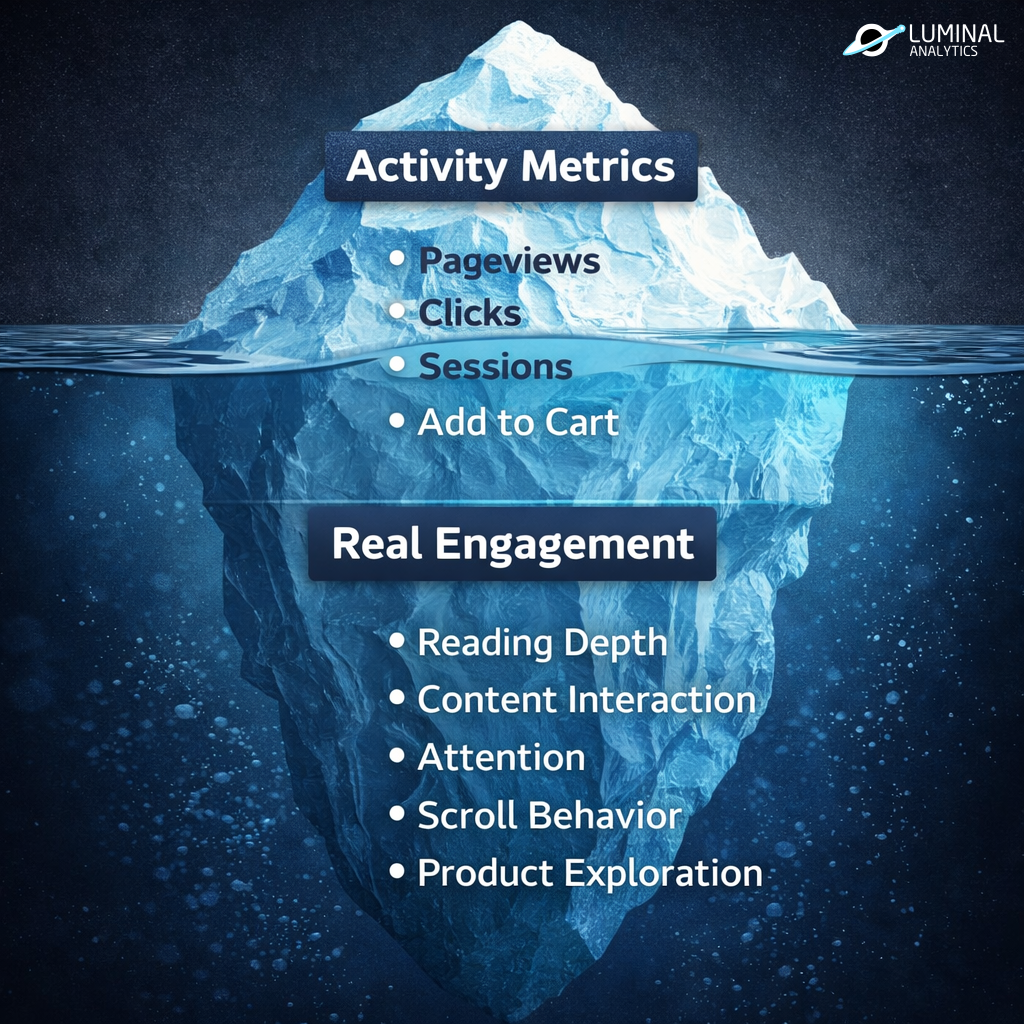
Many digital businesses believe they understand their audience.
After all, the dashboards look full.
Pageviews. Clicks. Sessions. Conversions. Time on page.
Everything seems measurable.
But there’s a quiet assumption hiding behind all those numbers:
that activity equals engagement.
In reality, those are not the same thing.
A pageview tells you that a page loaded.
It doesn’t tell you if the content was actually read.
A click tells you that someone interacted.
It doesn’t tell you whether they were interested or simply navigating away.
The same illusion exists in ecommerce.
A product page view looks like interest.
But it could just as easily be a visitor who immediately bounced.
An add-to-cart event looks like intent.
But it might represent hesitation, comparison, or simple curiosity.
When the signals are shallow, the conclusions become shallow too.
Teams start optimizing for what the dashboard shows:
more traffic more clicks more views
But those signals often say very little about what users actually experienced.
And over time, strategies begin to drift away from real user behavior.
The challenge for modern digital businesses isn’t the lack of data.
It’s understanding whether the data we rely on truly reflects engagement…
or just activity.
Because once you start measuring the difference, the way you interpret performance changes completely.