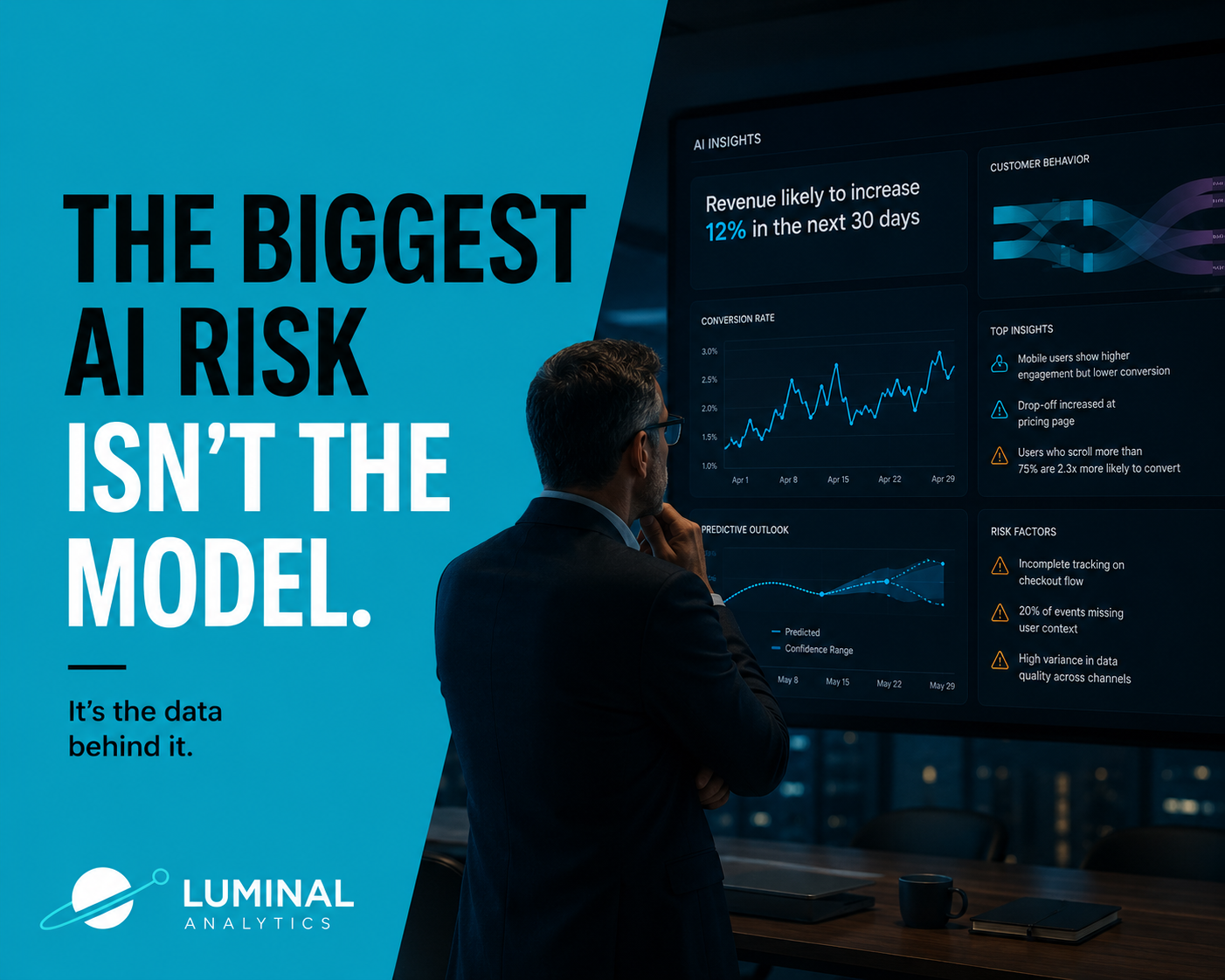
When people talk about AI risk, the conversation usually focuses on the models.
Which model is better.
Which model is faster.
Which model has better reasoning capabilities.
Which model generates more accurate answers.
But the more I watch organizations adopt AI, the more I think the biggest risk may not be the model at all.
It may be the data feeding it.
Because most AI systems don't create knowledge.
They interpret information.
They identify patterns.
They connect signals.
They generate recommendations based on what they observe.
And the quality of those outputs is directly influenced by the quality of the inputs.
That's where things get interesting.
Many organizations are investing heavily in AI initiatives while still struggling with challenges that existed long before AI arrived:
- incomplete data collection
- inconsistent definitions
- fragmented customer journeys
- disconnected systems
- shallow engagement signals
The models continue getting smarter.
But smarter models don't automatically solve incomplete understanding.
In some cases, they can simply help organizations arrive at the wrong conclusion faster.
Not because the AI failed.
But because the underlying signals never told the full story.
I think this is why trust is becoming one of the most important topics in enterprise AI.
Not trust in the technology itself.
Trust in the information used to generate the answer.
- Can we trust the recommendation?
- Can we trust the forecast?
- Can we trust the insight?
- Can we trust the business decision that follows?
Those questions rarely start with the model.
They start with the data.
That's one of the reasons we spend so much time thinking about behavioral signals at Luminal Analytics.
Because trust doesn't begin when an AI generates an answer.
It begins much earlier.
It begins with understanding whether we're collecting the right signals in the first place.
As AI becomes increasingly integrated into everyday decision-making, I suspect the organizations that gain the most value won't necessarily be the ones with the most advanced models.
They'll be the ones with the most trustworthy understanding of their users, customers, and business.