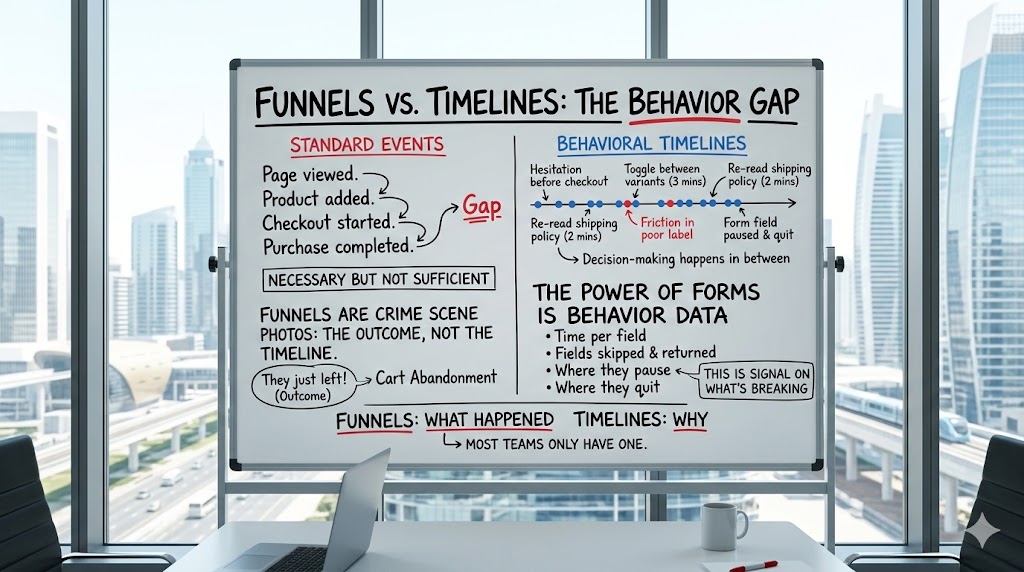
Page viewed. Product added. Checkout started. Purchase completed.
They're necessary. But they're not sufficient.
Because funnels are crime scene photos. They show the outcome. Not the timeline.
Someone abandons a cart. The event fires. But you don't know if they hesitated for two seconds or twenty minutes. You don't know if they re-read the shipping policy three times. You don't know if the form loaded slowly and they gave up.
You just know they left.
That's the gap.
Standardized events capture outcomes. But decision-making happens in between.
The hesitation before clicking "checkout." The time spent toggling between product variants. The friction in a form field that no one noticed was poorly labeled.
These signals aren't exotic. They're fundamental. And they're invisible to most tracking.
This is why forms matter more than teams realize.
A form isn't just a conversion point. It's behavioral data.
How long someone spends on each field. Which fields they skip, then return to. Where they pause. Where they quit.
That's not vanity metrics. That's signal about what's working and what's breaking.
When you only see funnel steps, optimization is guesswork.
- Is the CTA unclear?
- Is the price point wrong?
- Is the page too slow?
- Is trust missing?
You test. You iterate. You hope.
When you see behavior between the steps, patterns emerge. And patterns tell you where to focus.
Funnels explain what happened. Timelines explain why.
Most teams only have one.