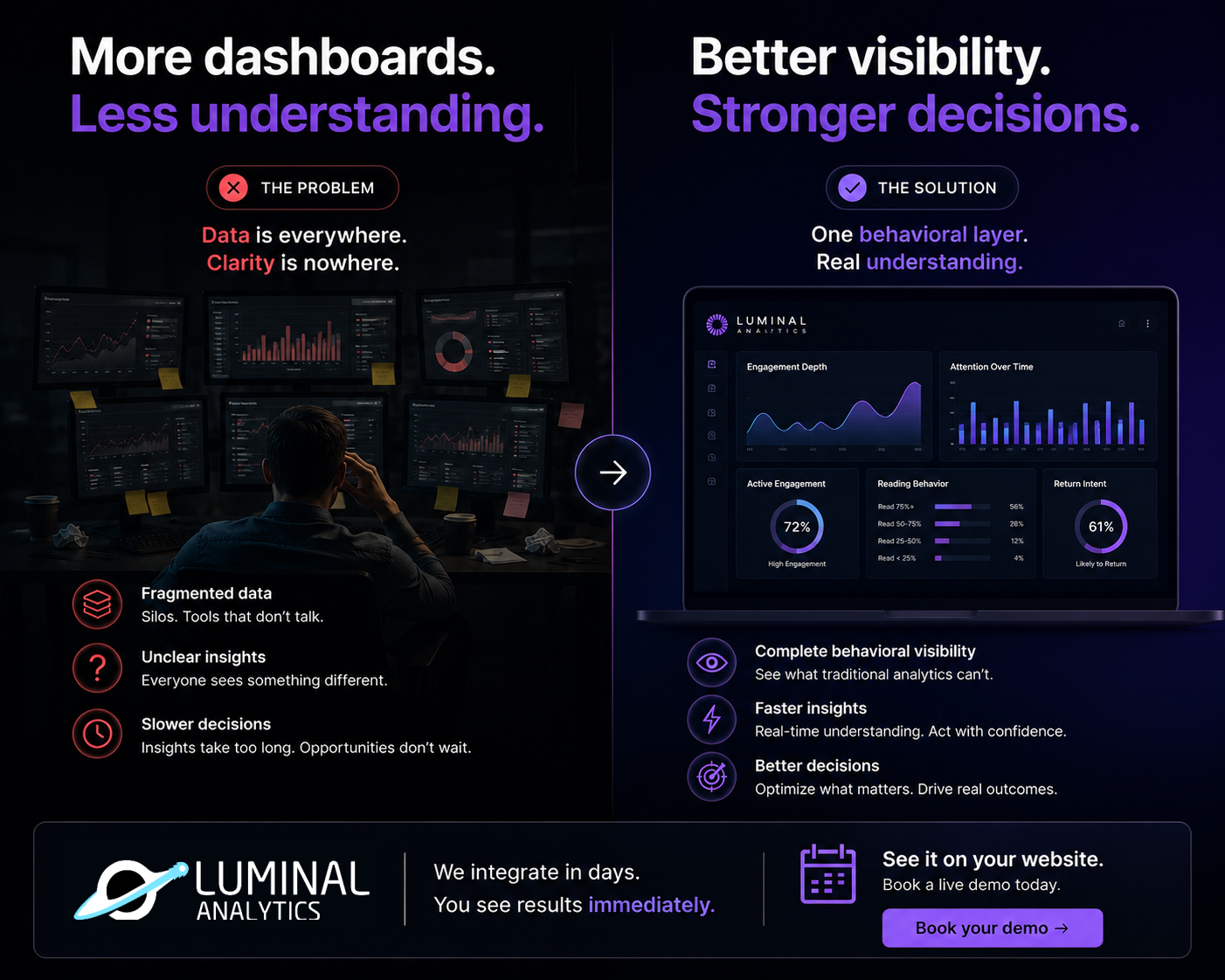
Marketing. Product. Executive. Revenue. Engagement. Performance.
And yet — teams still walk into meetings arguing about what's actually happening.
We've been in those rooms. Everyone has a number. Nobody has the same one. Someone from marketing pulls up one chart, someone from product pulls up another, and twenty minutes later you're debating whose data is right instead of making a decision.
It's not a people problem. It's a structure problem.
Data visibility got fragmented as tools multiplied. One platform tracks clicks. Another tracks ads. Another tracks Core Web Vitals. Another tracks engagement. They all live in separate places, speak different languages, and measure different slices of the same user.
And now teams are trying to layer AI on top of all of it — hoping it connects the dots that the stack never could.
It doesn't. It just automates the confusion.
When we were designing Luminal, this was one of the things we kept coming back to. Not "how do we add another dashboard" — but "how do we reduce the number of questions a team has to answer before they can trust what they're looking at."
The goal was always simpler: behavioral data that flows into the tools you already use, so engagement signals stop living in isolation.
More dashboards was never the answer. Better understanding was.
We're opening demos over the next few weeks — connecting Luminal directly into real environments and showing teams what a more unified picture actually looks like.
Because data should reduce confusion. Not create more of it.