From signal to action: where your data finally starts working
Earlier this week, we talked about two things:
- Your CDP is only as good as the data you feed it
- And most systems are missing critical engagement signals
So the natural question becomes:
- What happens when you actually fix that layer?
THE MISSING CONNECTION IN MOST DATA STACKS
Most modern data architectures are built to move data efficiently.
Platforms like mParticle excel at this:
- They collect
- They unify
- They distribute data across tools
But they are not designed to answer a deeper question: 👉 Are we capturing the right signals in the first place?
Because movement without meaning… is just faster confusion.
INTRODUCING THE MISSING LAYER
This is where a different approach comes in.
Instead of focusing only on orchestration, you start by improving what enters the system.
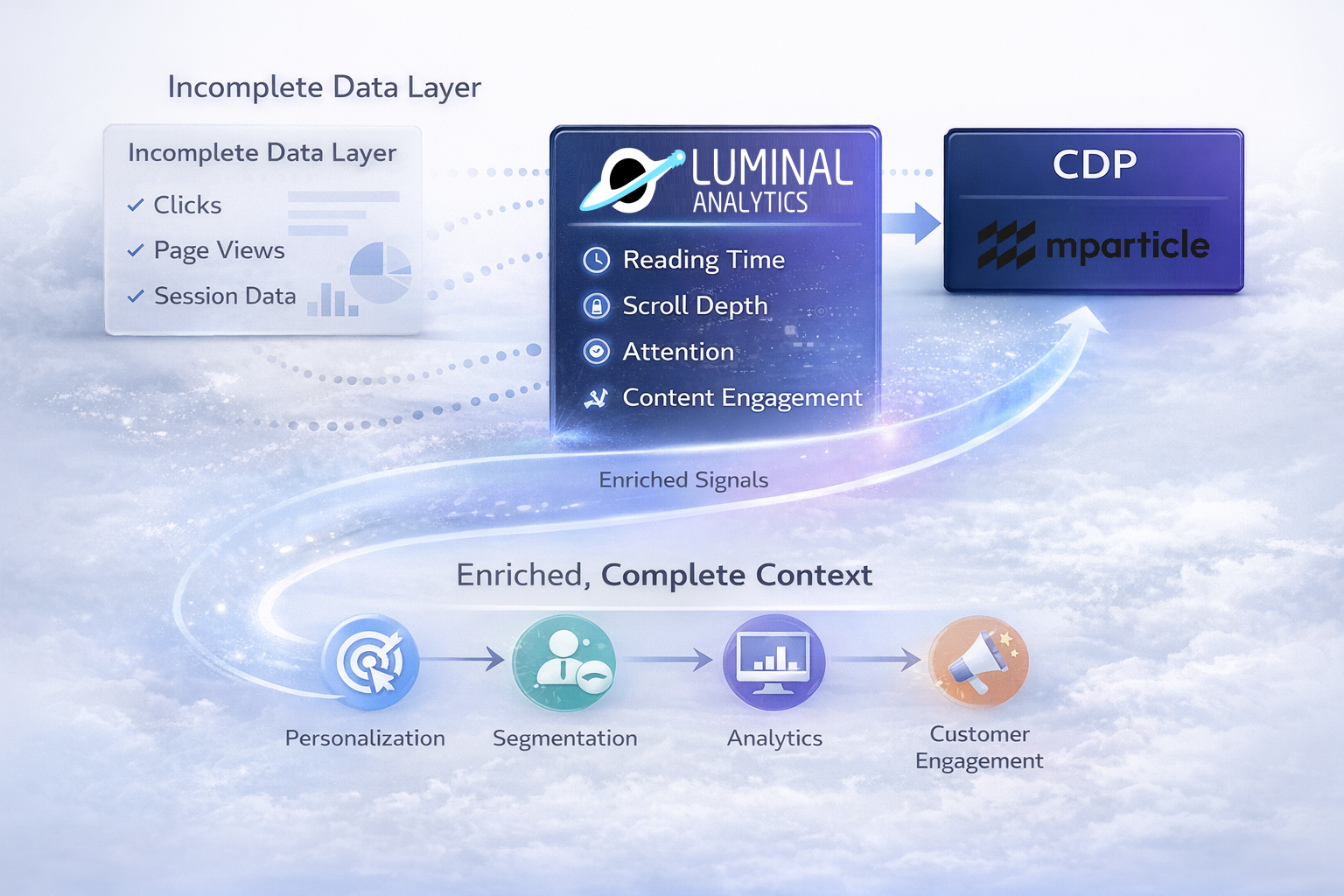
That means capturing:
- Real reading time (not just time-on-page)
- Scroll depth with context
- Attention patterns across content
- True engagement signals—not approximations
This is the layer most stacks don’t have. 👉 The signal layer
WHAT CHANGES WHEN YOU ADD IT
When you combine: A deep signal capture layer (Luminal Analytics) with A powerful distribution layer (mParticle)
Something important happens.
Your data doesn’t just move. 👉 It becomes meaningful before it moves
FROM BEHAVIOR → TO SIGNAL → TO ACTION
The flow starts to look like this:
- User behavior happens
- Luminal captures and enriches real engagement signals
- mParticle distributes that enriched data across your ecosystem
- Your tools finally act on complete context
Not partial signals. Not assumptions.
👉 Actual behavior
THE IMPACT ACROSS TEAMS
This isn’t just a technical improvement.
It changes how teams operate:
- Marketing builds audiences based on real engagement
- Product understands what users actually consume
- Data teams trust the signals they analyze
- Revenue teams optimize based on attention, not just clicks
WHY THIS MATTERS NOW
Most companies don’t need more tools.
They need their existing stack to work the way it was intended.
And that only happens when: 👉 The data entering the system reflects reality
FINAL THOUGHT
We’ve spent years optimizing how data flows.
The next shift is optimizing what flows through it.
Because: 👉 Better orchestration doesn’t fix missing signals 👉 But better signals unlock everything downstream