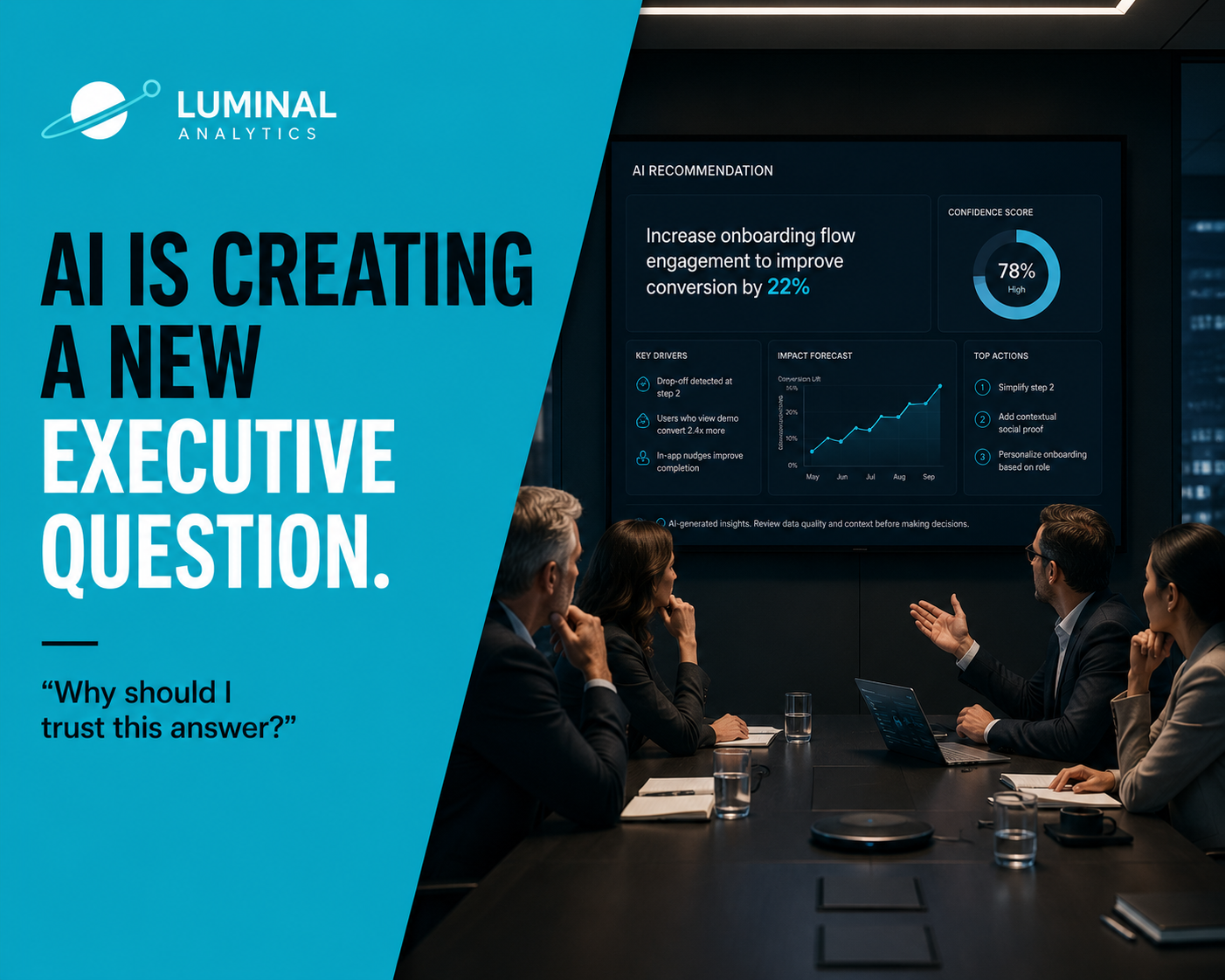
For years, business leaders have relied on dashboards to answer a simple question:
What do the numbers say?
Today, AI can answer that question faster than ever.
It can summarize reports.
Identify trends.
Highlight anomalies.
Generate forecasts.
Surface insights in seconds.
And the technology keeps improving.
But as AI becomes more embedded in business decision-making, I think a different question is starting to emerge.
A question that may become even more important than the answer itself.
Why should I trust it?
Not because AI is unreliable.
But because trust doesn't start with the output.
Trust starts with the information behind the output.
An AI-generated recommendation may look convincing.
A forecast may appear accurate.
A summary may sound intelligent.
But every answer is still dependent on the signals that were collected, interpreted, and analyzed along the way.
And that's where many organizations face a challenge.
The volume of data continues to grow.
The speed of analysis continues to increase.
Yet confidence in business decisions doesn't always grow at the same pace.
Because leaders aren't simply looking for answers.
They're looking for answers they can act on.
That requires understanding:
- where the data came from
- what signals were captured
- what context may be missing
- and whether the underlying behavior is being represented accurately
This is one of the reasons I believe trust is becoming one of the most important conversations in enterprise AI.
Not trust in the model.
Trust in the foundation underneath it.
At Luminal Analytics, we've spent a lot of time thinking about behavioral intelligence through that lens.
Because before organizations can trust AI-generated insights, they first need confidence that they're collecting meaningful signals about how users actually interact with their products, content, and experiences.
AI can accelerate decisions.
But trust is what turns insights into action.
And in the years ahead, that may become one of the most valuable competitive advantages an organization can build.